NOTE: Alyshia is one of our Diversity Interns. For more info on the Diversity Program, please visit: http://www.pitzer.edu/admission/diversity/index.asp
Friday, March 25, 2011

FINALLY!!! Reading season is over and ADMIT packets are on the way!!!
After months of traveling and weeks of reading applications... the time has come! Committee is done and I can proudly say that I have successfully helped shape the future class of 2015!!!
Do you ever wonder what happens to that BIG BRIGHT ORANGE CONGRATULATIONS envelope the moment it leaves our office??? Well allow me to provide you with a quick explanation:
1. The admit packet is labeled (Alyshia is one of our Diversity Interns)
 2. Fernando (our Graduate Admission Fellow) seals the envelope with lots of PZ LOVE!
 3. Files are ready to leave the office.
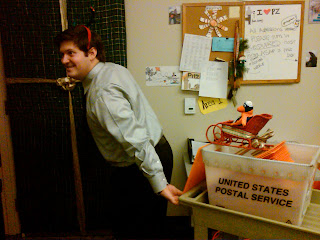
 4. Fernando poses once more with the admit packet!


 8. And there you have it... the admit packets awaiting delivery.

Do you ever wonder what happens to that BIG BRIGHT ORANGE CONGRATULATIONS envelope the moment it leaves our office??? Well allow me to provide you with a quick explanation:
1. The admit packet is labeled (Alyshia is one of our Diversity Interns)
 2. Fernando (our Graduate Admission Fellow) seals the envelope with lots of PZ LOVE!
 3. Files are ready to leave the office.
 4. Fernando poses once more with the admit packet!

5. Santiago (Associate Director) helps load the car with all the packets to be taken to the post office.

6. We (the counselors) drive to the Claremont Post Office to hand deliver the admit packets.


 8. And there you have it... the admit packets awaiting delivery.

Wednesday, January 5, 2011
HAPPY NEW YEAR... and now back to applications!
"Hello friends of the Pitzer College Office of Admission. I hope you all had a wonderful holiday and enjoyed a spectacular New Years! After all of my fall travel and recruiting, I needed a break and decided to "fly the coop". Where did I go??? I headed to the only place where sagehens can relax and grab some of the best Cuban food... MIAMI!" -Cecil T. Sagehen

 Until then... open mail (paper cuts), alphabetize, file, etc... it's like I'm an admission robot!!! ha ha.

 After a nice and peaceful winter break, we (the counseling staff) are all back in the office and ready to process those applications. Tons of mail, lots of paper cuts, and so much alphabetizing... but of course it is all worth it in the end. Being an admission counselor has helped me understand how more than ever, we need more students like YOU!

So please bare with me in the next few weeks. If you submitted an application, it is being processed at the moment thanks to our entire counseling and support staff. No need to call... that recommendation letter is NOT late, those SAT scores will arrive soon, and your transcript should be arriving any day now. What more do you have to worry about? You have done your part of the application... so just sit back, relax, continue being the rock star student you are and wait to hear back from us in the coming months.

 Until then... open mail (paper cuts), alphabetize, file, etc... it's like I'm an admission robot!!! ha ha.
Friday, December 17, 2010
Don't worry... Early Decision letters are on the way!
Sing it with me...
Cecil, the orange-nosed Sagehen had a very shiny nose. And if you ever saw him, you would even say it glows. All of the other Sagehens used to laugh and call him names. They never let poor Cecil join in any Sagehen Sports. Then one foggy Pitzer Eve, the Admission Dean came to say: "Cecil with your nose so bright, won't you deliver my mail tonight?" Then all the Sagehen loved him as they shouted out with glee, Cecil the orange-nosed Sagehen, you'll go down in Early Decision history!


Danny Irving, Assistant Director of Admission, lends a helping hand to help guide Cecil and the ED letters to the mail room.
Sing it with me...
Cecil, the orange-nosed Sagehen had a very shiny nose. And if you ever saw him, you would even say it glows. All of the other Sagehens used to laugh and call him names. They never let poor Cecil join in any Sagehen Sports. Then one foggy Pitzer Eve, the Admission Dean came to say: "Cecil with your nose so bright, won't you deliver my mail tonight?" Then all the Sagehen loved him as they shouted out with glee, Cecil the orange-nosed Sagehen, you'll go down in Early Decision history!


Danny Irving, Assistant Director of Admission, lends a helping hand to help guide Cecil and the ED letters to the mail room.
Wednesday, December 15, 2010
17 MORE DAYS...
Ok, so I don't mean to scare any of you, but just a friendly reminder that applications are DUE: JANUARY 1, 2011.
On a lighter note, I wanted to share with you all a letter that was recently written on behalf of current Pitzer Student, Michael Landsman P'12 :
A little sagehen tells me you've started to fill out your application to Pitzer but have yet to press "submit." I know senior year is busy and the college process is strangely both the most stressful and protracted experience one faces in school. In fact, I finished most of my applications on New Year's Eve! However, on the first day of that winter break I had a small panic attack while watching Juno with a friend, using my iPhone to confirm that I had indeed sent in my Pitzer app.
My freak-out was for good reason because three years later I know applying to Pitzer was one of the better decisions in my life! Pitzer might not be for everyone, but those of us here deeply love this place. You can feel it when picking figs and oranges from our garden with friends after class, when rolling down the mounds from laughter at a midmorning conversation, or grooving to homespun music on the porch of the Grove House.

However, Pitzer is more than fun and games (although we have plenty of bike polo and hoops in our year-round sunshine), it provides one of the most unique, and important, educational programs around. Today's problems and tomorrow's solutions don't divide themselves neatly into disciplinary boundaries so neither do our courses. At Pitzer, "interdisciplinary" means studying genetics with a historian and a neuroscientist, assessing the environment through politics and poetry and discussing race relations through film.
In today's global society one must be able to think across cultures, so Pitzer strives for diversity in all aspects. We get to study African politics with a professor who fled Sudan and learn about gang culture from life-long Los Angeles activists. Through Pitzer study abroad, we can explore Nepali terrestrial radio and intern with a local pundit or complete biology courses at our health clinic in Costa Rica.

Pitzer is a strong community because social responsibility is at our core. Beyond the confines of campus, Pitzer students have long-standing partnerships with local non-profits and constantly develop creative new ways to improve our shared experience. On campus, students usher changes to reduce dining hall waste, design new sustainable residence halls and even hire and promote professors. Here, students take part in governance - so we have a real voice. Of course there are other ways to give back such as working in the bike shop, helping plan spring's Kohoutek Music and Arts Festival or whipping up burritos at the student-run Shakedown Café.
Perhaps the best part of Pitzer is simply the freedom to be who you are. I'm continually fascinated and inspired by the myriad personalities who live and learn here. Pitzer teaches you that to achieve happiness and success, the best formula to follow is your own. If you are still reading this letter, at least some of this description has probably tickled your fancy. Now remember, you can't take advantage of all this great stuff unless you apply, so press "submit" for Cecil's sake!
Sincerely,
Michael Landsman
Pitzer College
Class of 2012
Wednesday, November 24, 2010
Waiting for the Incredible Hulk
November 16, 2010
By Angel B. Pérez
From Inside Higher Ed: http://www.insidehighered.com/views/2010/11/16/perez
If K-12 education is waiting for Superman, then higher education in America must long for the Incredible Hulk. In the movie "Waiting for Superman," Davis Guggenheim highlights the problems that plague elementary and secondary education in this country, and illustrates how a system challenged with systemic injustice and bureaucratic red tape is obstructing students from attaining the American dream -- a shot at college.
But what happens when those students who make it arrive at the doorstep of the ivory tower and realize (like Geoffrey Canada, the educator in the movie whose childhood awakening inspired the documentary's title) superheroes don't exist? Higher education leaders paint images of colleges and universities in America that we don't live up to. Like the fictional characters we grow to admire in our infancy, postsecondary education can often disappoint.
Of the students who enter college in America, 43 percent don't graduate, and those who do typically don't complete in four years. Between 1971 and 2009, the gap in bachelor's degree attainment between white and Hispanic students grew from 14 to 25 percentage points. At public four-year colleges, less than half of the recipients of Pell Grants -- our lowest-income students -- graduated with a bachelor's degree. For African-American students, the proportion is even smaller.
We have a for-profit college sector that preys on low-income and first-generation students who are not savvy about the college application and financial aid process. These schools have produced the highest student loan default rate in the country and amongst the lowest graduation rates in the nation.
There are students who attend universities where they have little contact with actual professors because professors are so busy doing research. You can't blame the faculty, since promotion and prestige in academia is based on research and publication outcomes, not teaching and student engagement. Those who lose are our students, who experience education from a factory, instead of a second home where they are nurtured and cultivated.
In the world of elite colleges and universities, institutions compromise their values to compete for top ratings in U.S. News & World Report. They don’t always engage in student’s best interests; rather institutional policies are shaped to ensure climbing a few numbers on a report that earns a magazine millions of dollars and tells students and parents nothing about a college where they will thrive.
Most shocking of all are the unethical practices of college enrollment offices that disguise information in financial aid packages to enroll as many students as they can -- at the lowest price. Since our government does not require colleges and universities to provide certain basic information in a financial aid package, colleges sometimes provide the minimum amount, knowing that naïve students will enroll, even if they really can't afford it. We have a multibillion-dollar student loan industry and the highest rate of default in our history. Some would argue it's the consumer's fault, but colleges and universities that hide total cost of attendance and don't counsel students about the implications of borrowing are just as much to blame.
Higher education is an industry at risk. We focus on opening the doors for students, but we have not done a good job of making sure they persist. We are moving further away from our values, and if the pendulum does not swing drastically in the opposite direction, we will be the focus of the next documentary that shakes a nation and inspires a movement. We should not set our educational agenda around the egos of faculty and administrators, or the hopes of gaining prestige. We should do what's ultimately best for students. If a college education is the dream our young people reach for, it's up to those of us who lead it to create a system that embodies the strengths of the superhero they truly deserve.
Angel B. Pérez is director of admission at Pitzer College and a fellow at the Bowen Institution for Higher Education Policy at Claremont Graduate University.
Thursday, November 18, 2010
L.A. Local Travel: DONE!
What do food; Los Angels, community engagement and Pitzer have in common?
Keep reading and find out…
 So I have bee on the road for the past two and a half months recruiting students from all parts of the Southeast, Northwest, and of course beautiful Southern California. This week I wrapped up my local Los Angeles high school visits. I enjoy having the opportunity to visit so many different high schools and meet so many interested and talented students from L.A. Aside from the recruiting, I always go out of my way to make a stop at Homegirl Café for breakfast or lunch while I am in the Los Angeles area.
 At this point you may be asking, “So what does this Homegirl Café have to do with Pitzer?” Well, I am glad that you are so curious! Homegirl Café is a division of Homeboy Industries, which was established over two decades ago by Father Gregory Boyle in Los Angeles. It began as a jobs program in 1988, offering alternatives to gang violence in one of the toughest neighborhoods in the city, the program soon grew beyond the parish.


Community Based Education connects students and faculty with local organizations to create community-based research, service learning and experiential education opportunities that enhance the social, environmental, cultural and economic health of our communities. CEC serves a liaison between the academic institution and community partners, provides internship opportunities, and assistance with funding and programming, as well as providing logistical support to students, faculty, staff, and community partners.
If you would like to learn more about CEC please visit the website:
What do food; Los Angels, community engagement and Pitzer have in common?
Keep reading and find out…
So I have bee on the road for the past two and a half months recruiting students from all parts of the Southeast, Northwest, and of course beautiful Southern California. This week I wrapped up my local Los Angeles high school visits. I enjoy having the opportunity to visit so many different high schools and meet so many interested and talented students from L.A. Aside from the recruiting, I always go out of my way to make a stop at Homegirl Café for breakfast or lunch while I am in the Los Angeles area. At this point you may be asking, “So what does this Homegirl Café have to do with Pitzer?” Well, I am glad that you are so curious! Homegirl Café is a division of Homeboy Industries, which was established over two decades ago by Father Gregory Boyle in Los Angeles. It began as a jobs program in 1988, offering alternatives to gang violence in one of the toughest neighborhoods in the city, the program soon grew beyond the parish.
Mission Statement:
“Jobs not Jails: Homeboy Industries assists at-risk and formerly gang-involved youth to become positive and contributing members of society through job placement, training and education.”
“Jobs not Jails: Homeboy Industries assists at-risk and formerly gang-involved youth to become positive and contributing members of society through job placement, training and education.”


For more information about Homeboy Industries, please visit their website and learn more about some of the many opportunities in which you can help:
At Pitzer College, we have the Community Engagement Center (formerly the Center for California Cultural and Social Issues or CCCSI). Since its founding in 1963, Pitzer College has been committed to teaching students to be responsible citizens of communities both local and global by applying the study of liberal arts to concrete actions that benefit others. CEC works in the community creating partnerships, not to dispense "expert" solutions to pre-defined needs, but to identify and engage resources — both human and material — within the community. Under leadership and the guidance of the Steering Committee, the Center supports innovative community-based projects by offering research awards and fellowships. In turn, the Center's community partners present faculty and students with extraordinary opportunities to engage in applied problem-solving activities.
Community Based Education connects students and faculty with local organizations to create community-based research, service learning and experiential education opportunities that enhance the social, environmental, cultural and economic health of our communities. CEC serves a liaison between the academic institution and community partners, provides internship opportunities, and assistance with funding and programming, as well as providing logistical support to students, faculty, staff, and community partners.
If you would like to learn more about CEC please visit the website:
Subscribe to:
Posts (Atom)